


Current international events / SNTS
More information:
Régió-10 Kft. – Fanni Mravik
Tel.: +36 62 710 500
Mobile: +36 20 480-0556
E-mail: info@regio10.hu
Coming soon!
Coming soon!
Art Hotel Szeged
6720 Szeged, Somogyi u. 16.
Distance from the venue: 4 minutes walking
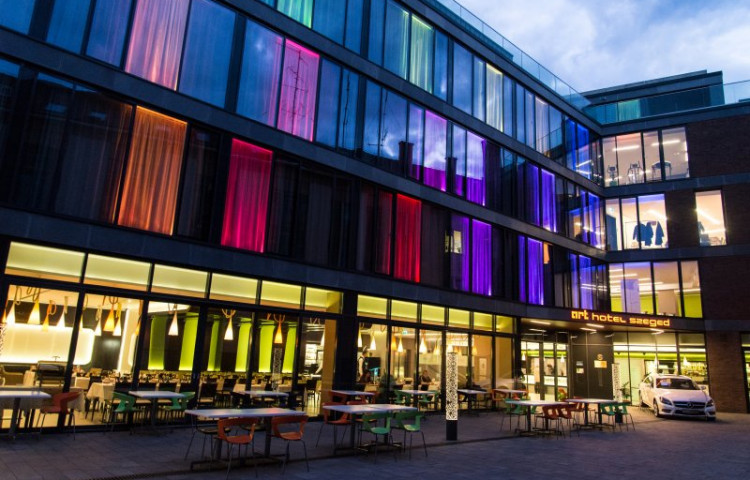
The Art Hotel Szeged is located in downtown of Szeged facing directly to the Cathedral Square. The 4-storey hotel has 75 rooms. The rooms are equipped with comfortable king size or with two single beds, safe, telephone, air conditioning, LCD TV, hair dryer and free wi-fi access. Parking lots are available in the garage.
Hunguest Hotel Forrás
6726 Szeged, Szent-Györgyi A. u. 16-24
Distance from the venue: 5 minutes driving
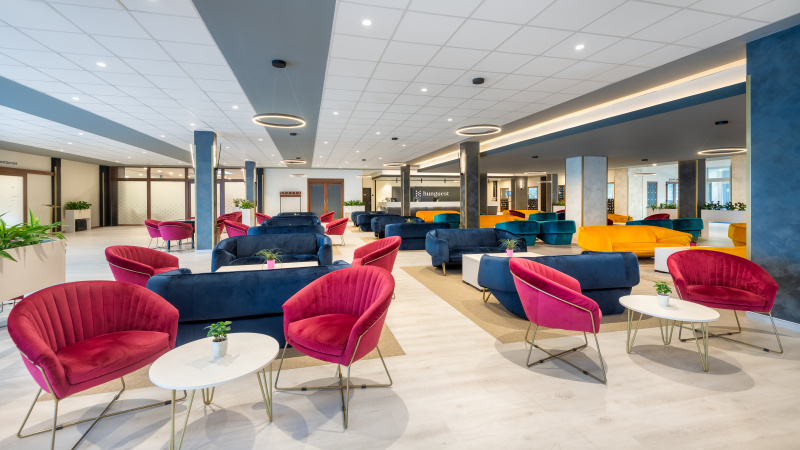
The Hunguest Hotel Szeged is a twenty-minute walk away from the city centre and is located in New Szeged. The hotel is completely renewed and offers 199 four- star rooms with a high standard of service. The new services are: four-track bowling facility with a bar, an X-box room and a playing room is available for children. The spa complex („Napfényfürdő Aquapolis Szeged”) connects to the hotel directly. It offers wellness, adventure and spa facility. Parking lots are available in the garage of the Aquapolis.
Novotel Hotel
6721 Szeged, Maros u. 1.
Distance from the venue: 16 minutes walking
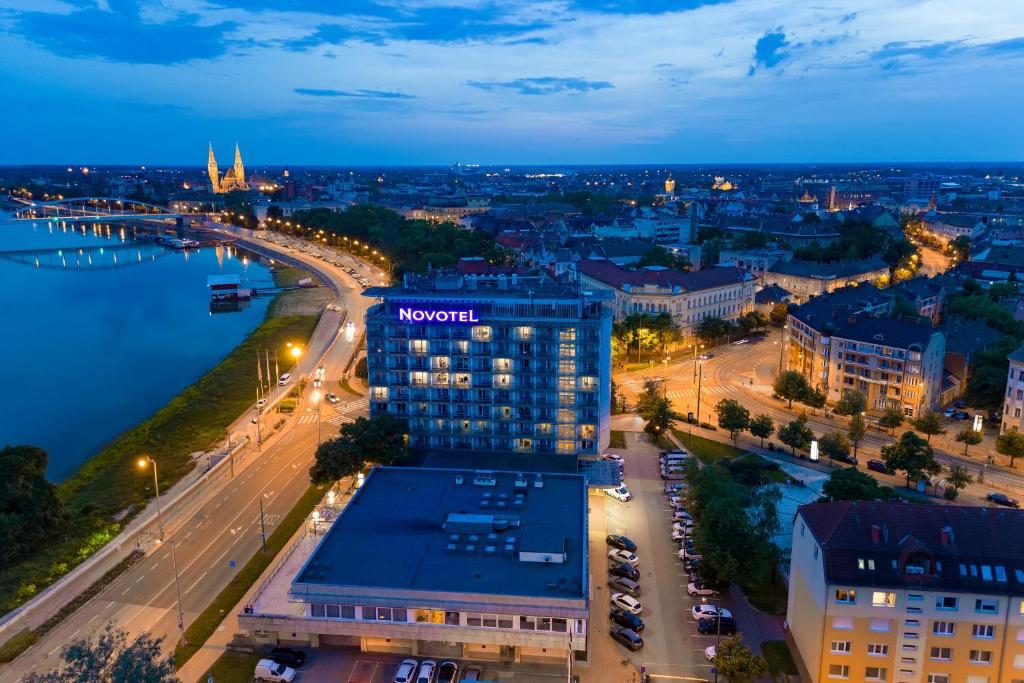
The Novotel Szeged is centrally located in Szeged, on the bank of the River Tisza. Free WiFi access is available in all areas.
All air-conditioned rooms boast a balcony and views of the river. They also have a flat-screen TV with satellite channels, a desk, an electric kettle and a minibar.
Guests can also relax on the terrace, while there is also a children’s corner at guests’ disposal. Luggage storage is available for free, while staff at the 24-hour reception can help with tickets and information on tours in the area.
Dóm Hotel
6720, Szeged, Bajza u. 6.
Distance from the venue: 4 minutes walking
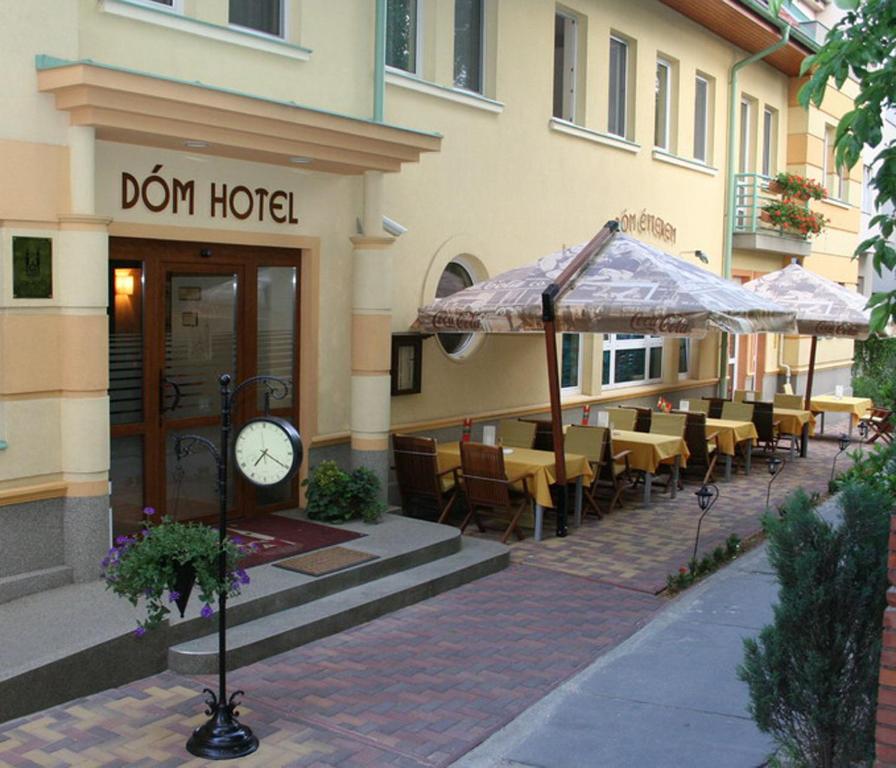
The Dóm Hotel is located in the heart of downtown Szeged, just a few steps from the towers of the Votive Church, offering comfortable, air-conditioned rooms, a restaurant, a sauna, and parking facilities. 14 double rooms and two suites on two floors (with free Wi-Fi, TV, minibar, air conditioning, and tea and coffee making facilities in the suites) ensure the comfort of our guests.
Tisza Hotel
6720, Szeged, Széchenyi tér 3.
Distance from the venue: 10 minutes walking
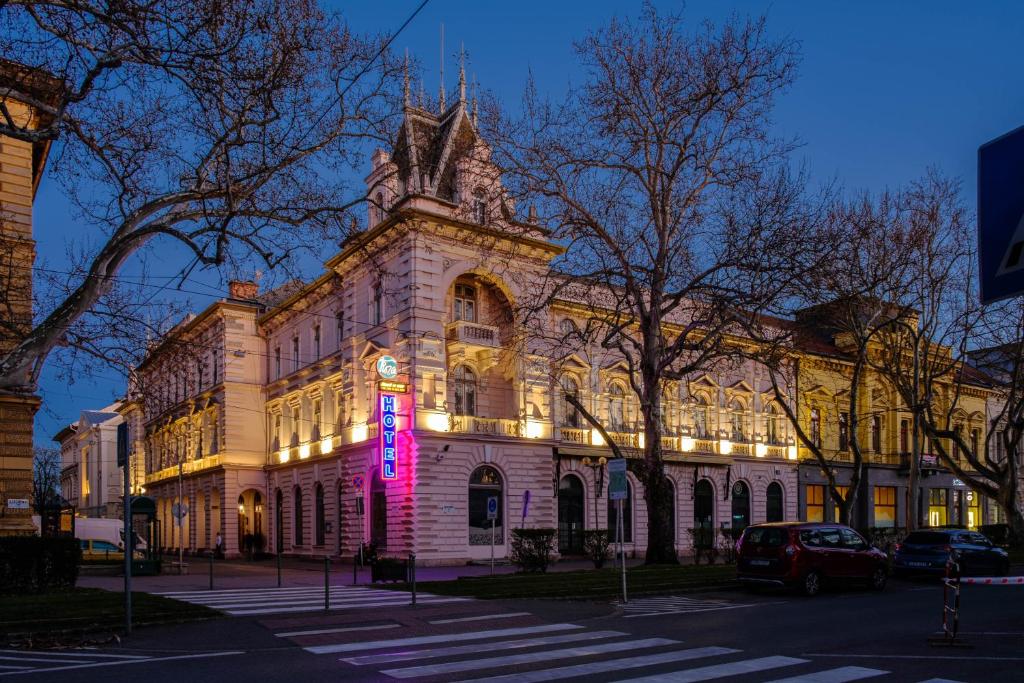
The elegant Tisza Hotel is located in the city center of Szeged, on Széchenyi Square. The hotel was built at the end of the 19th century and has retained its special turn-of-the-century atmosphere. The hotel welcomes its guests with elegant suites and air-conditioned Superior and Classic rooms. The rooms are furnished with colonial-style furniture, renovated bathrooms, LCD color TVs, mini refrigerators, direct dial telephones, and Cardo mattresses, and free WiFi is available in the hotel.
Mozart Hotel
6720, Szeged, Oskola u. 16.
Distance from the venue: 4 minutes walking
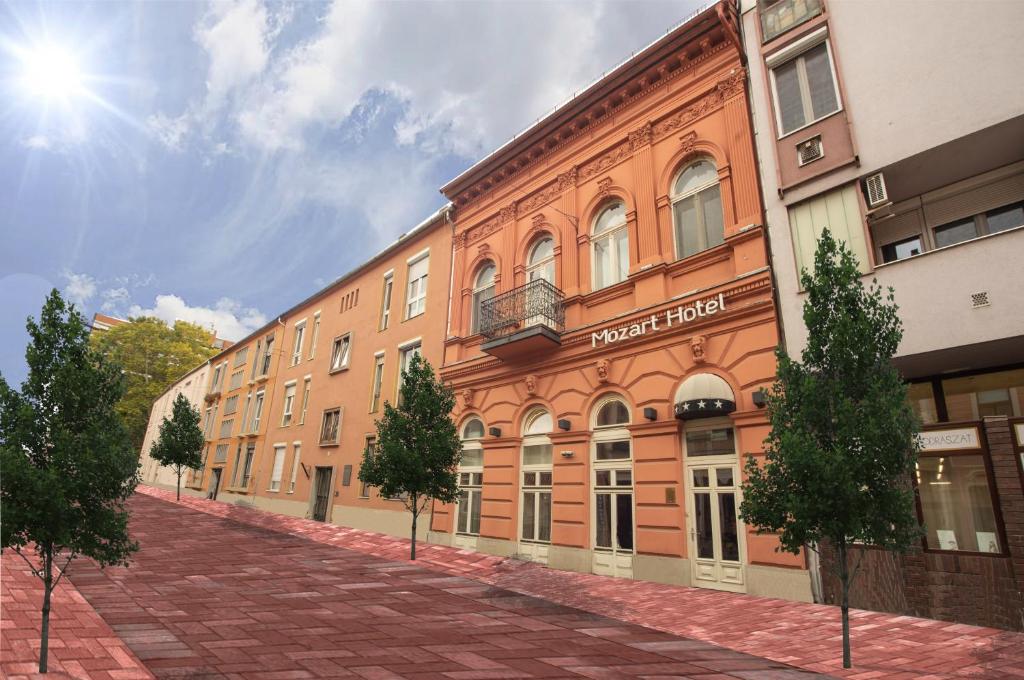
The Mozart Hotel is located in the heart of the city center, like a jewel box that exudes a family atmosphere and combines the beauty of the Baroque era with modern comforts. The 4-story building is equipped with an elevator and has 15 double rooms. The guests can enjoy both the Mozart-era interior and the comfort of state-of-the-art technical equipment. All rooms have a minibar and individual air conditioning, entertainment is provided by LCD televisions and Wi-Fi internet connection.
Auris Hotel
6725, Szeged, Boldogasszony sugárút 14.
Distance from the venue: 5 minutes walking
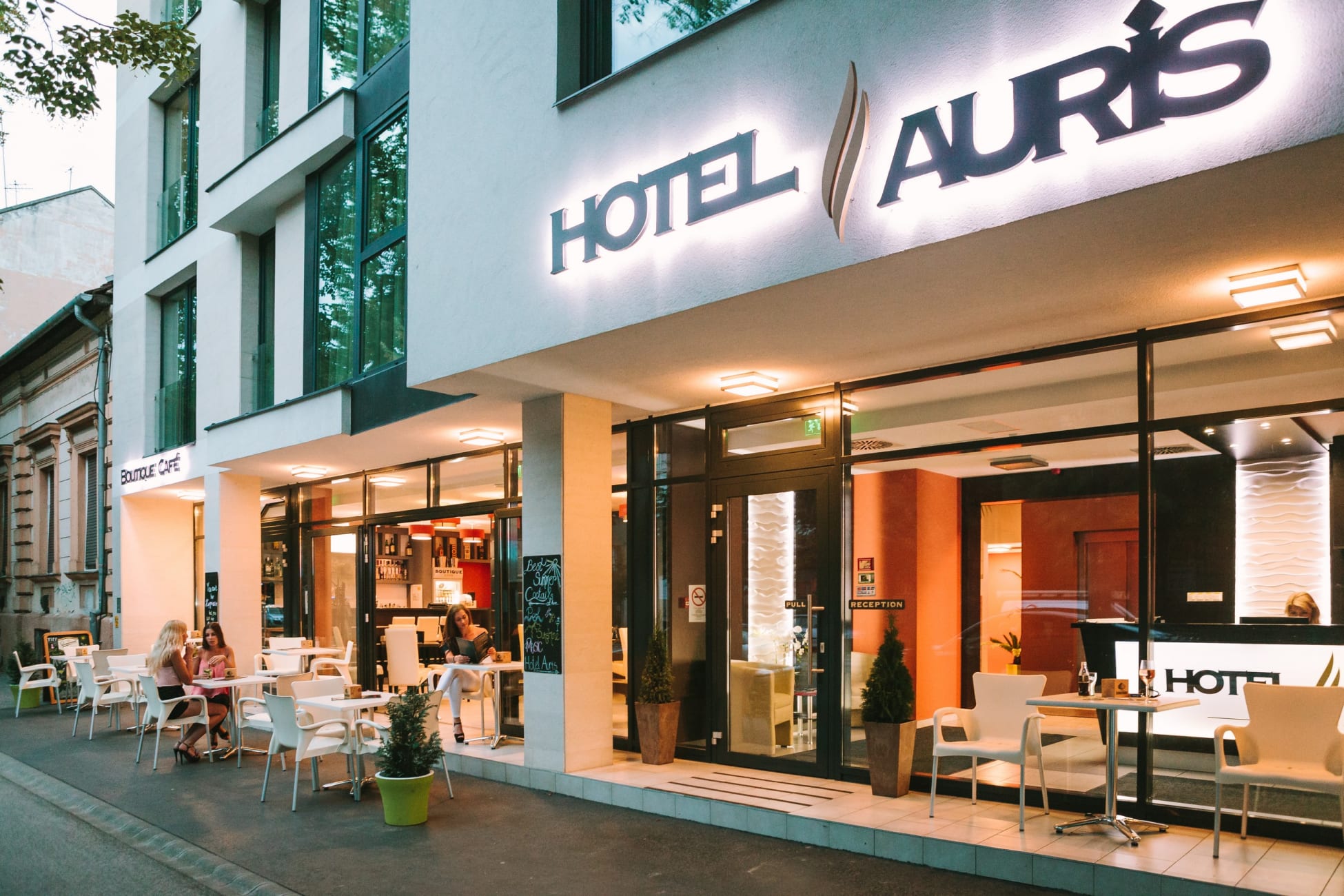
Opened in 2015, the elegant Auris Hotel with its clean design is located in the heart of downtown Szeged. The pleasant, modern hotel offers 27 tastefully furnished rooms. Additional services for hotel guests: the restaurant serves a delicious buffet breakfast, and those seeking a wellness experience can enjoy the Finnish sauna and massage services. Parking spaces are available at the hotel, which can be used for an extra charge and with advance booking.
Science Hotel
6722, Szeged, Petőfi Sándor sugárút 17.
Distance from the venue: 8 minutes walking
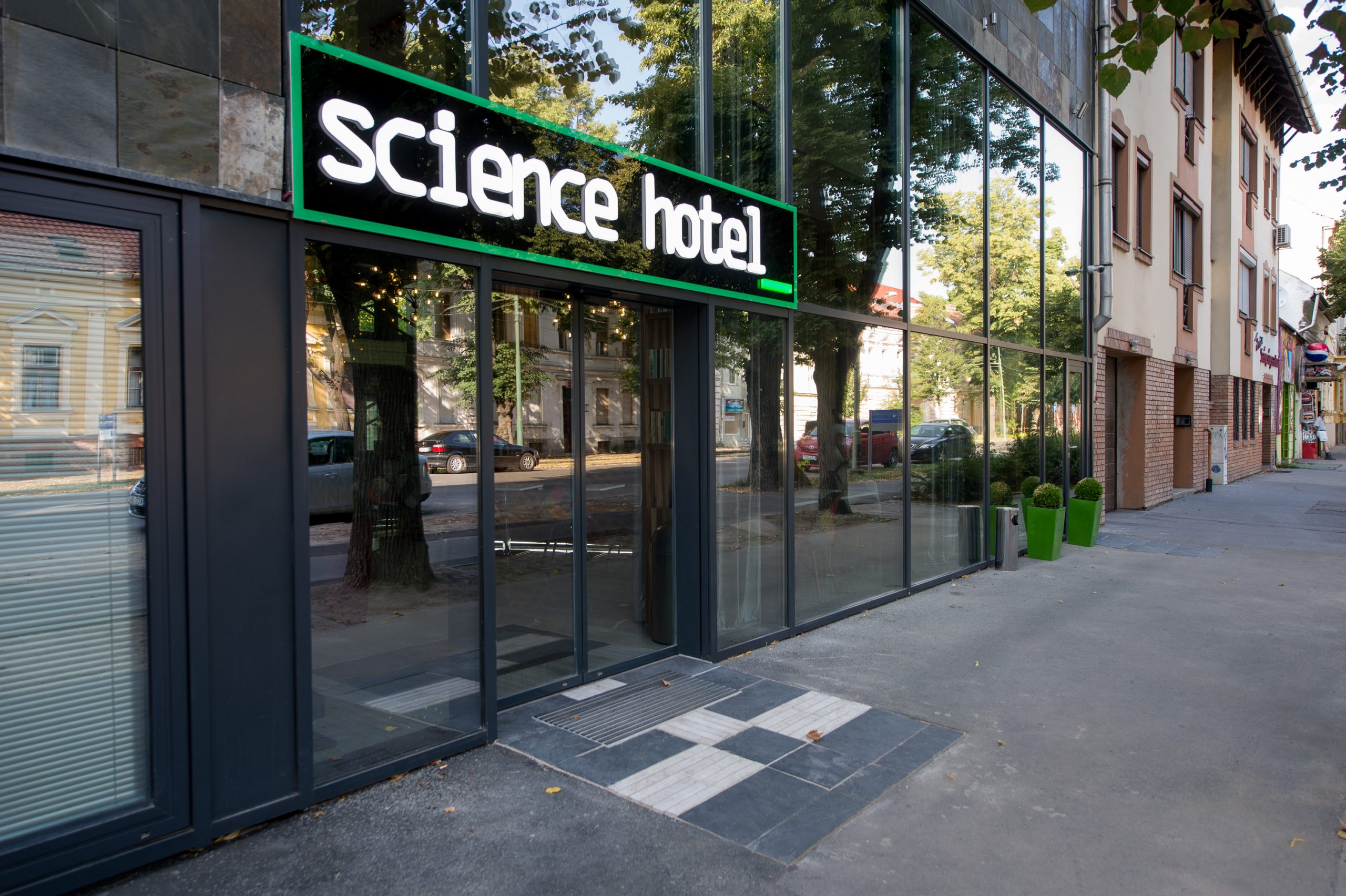
This eclectic-style hotel, located in the heart of the city center, has 43 uniquely designed rooms and a conference room. The city’s first design hotel is an elegant venue for smaller conferences, business meetings, and seminars.
Parking spaces are available at the hotel, which can be used for an extra charge and with advance booking.
Piano Hotel
6722, Szeged, Petőfi Sándor sugárút 4.
Distance from the venue: 8 minutes walking
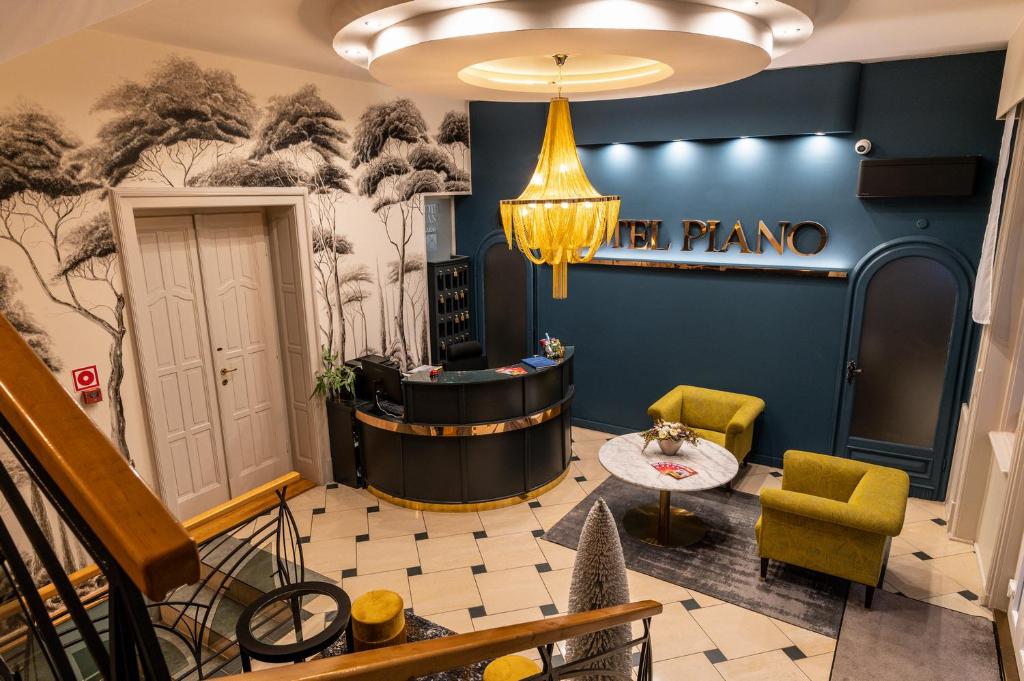
Hotel Piano is a small hotel with 20 rooms, reminiscent of Italy, located in the center of Szeged. After renovations in September 2021, the hotel reopened with a fresh new look and design. The style of the hotel has been adapted to the Mediterranean atmosphere of the city. For parking, please inquire at the hotel reception, especially if you have made a reservation. There are 8 parking spaces available at the hotel, which can be used for an extra charge and with advance booking.
Coming soon!
Coming soon!
Coming soon!
Sights in Szeged
Szeged is the third largest city of Hungary, the largest city and regional centre of the Southern Great Plain and the county town of Csongrád county. The University of Szeged is one of the most distinguished universities in Hungary.
The famous Open Air Plays of Szeged (first held in 1931) are one of the main attractions; which are held every summer celebrated as the Day of the city on May 21.
Cathedral Dóm
The original plans by Frigyes Schulek. The cathedral’s construction plans were started by Foerk Ernest in 1913. At current location of the Cathedral, the church of St. Demetrius had stood. The foundation-stone ceremony took place on June 21, 1914. The Church was formally dedicated on October 24, 1930.
It is the fourth largest church in Hungary. The dome is 54m outside (33m above the inside floor) and the towers are both 91m high. The “Heroes’ bell” in the tower on the Tisza side weighs 8600kg.
St. Demetrius Tower
Outside the Votive church stands the Saint Demetrius Tower, the oldest architectural relic of the city. The remain of the church erected in honour of Saint Demetrius of Thessaloniki living in the 4th century is called the Dömötör Tower by the people of Szeged.
Musical Clock
The tunes of this unique piece of art by watchmaker Ferenc Csúri could be first heard at the Open Air Festival in 1936. The music clock on the upper level of the building, opposite the main entrance of the Votive Church is a symbol of medieval universities. Twice a day, at 12.15 and 17.45 it shows the walk of the graduating students at the end of the academic year.
Móra Ferenc Museum
You can find works by Hungarian painters like Munckacsy, Csok, Rudnay or Rippl-Ronai, a natural history exhibition, one on local folklore, and some temporary ones.
Black House
The building standing at the corner of Somogyi and Kelemen Street is unique in its style, appearance and location. It was built in English romantic style in 1857 on the base of the designs by Károly Gerster. The name of the house, originally a commercial townhouse, then a casino, comes from the dark grey-black colour used on the exterior earlier. Black House has been providing permanent exhibit rooms for the historical department of Ferenc Móra Museum, regularly accommodating temporary exhibitions related to the past of the city.
Synagogue
The “new” synagogue and the head office of the Jewish community was planned by Lipót Baumhorn after winning the contest of design. The building operations began in the August of 1907 and ended by October. We can recognise nearly all architectural styles in this monumental 48,5 meter (158,5 feet) tall building. The basic overall appearance is moorish-art nouveau. The insertion by sprandrels, the rib-like wall above the organ is Gothic, the columns holding the galleries are Roman. The most beautiful part of the synagogue is the interior of the dome, which symbolizes the world.
Serbian Orthodox Church
The building was erected in honour of Saint Nicholas in 1778 in Baroque style to serve the local Serbian community. The interior is typical to Orthodox Christian churches.
Reformed Church – Honvéd tér
The history of the congregation is short as it was created no longer than half a century ago. During the first half of the twentieth century the only Reformed church of the town was theat of “Kálvin tér” built in 1884. The number of devotees significantly grew after the resettlement of the University of Kolozsvár to Szeged; the Calvinist refugees of Transylvania and Banat and the high number of university students further increasing the congreagtion following the border modifications resulted from the Trianon peace treaty. That was why the Presbiteriat made the decision of building a new Calvinist church in 1928.
REÖK – Regional Art Center
On the corner of Lajos Tisza boulevard and Kölcsey street stands one of the most unique works of Hungarian Art Nouveau. Built in the style that foreign literature labels “Hungarian Jugendstil”, the house was designed by Ede Magyar, and completed in 1907. The hundred-year-old Art Nouveau palace opened its doors in August 2007. The Reök palace – Regional Arts Centre try to fulfill multifunctional cultural purposes, such as hosting the city’s art gallery.
Water Tower
The Water Tower of Szeged was constrcuted in art nouveau style (called secessionist in Hungary) in 1903/04 on the plans by Szilárd Zielinski. The decorations are due to Flóris Korb. The Tower is open to the public. In addition to enjoying the beauty of the building, visitors can take a look at the exhibition with paintings, drawings, photos and photo-drawings introducing soda water production and the history of physics. From the tower’s top floor you can enjoy the amazing view of the city.
Szeged ZOO
Szeded Zoo was opened as part of the amusement park in 1985. At that time there were only a few animals in the park: 3 monkies, 1 phyton, some deers and boars. The expansion started with the establishment of the Southern America section and continued with the monkies’ house, the parrots’ house, Asia-house and a typical Hungarian farm etc. The newest part is the penguins’ home and the management is planning to build a raja covey where the kids can even touch the animals.
Szeged Zoo also cares about nature conservation and education: there is a Rescue Center and a ZooSchool. On the International Earth, Water and Animal Day, the zoo-staff organizes special events for kids, where they can learn about the animals and nature having fun at the same time. The Zoo is very successful at reproduction of endangered animals: there are some little cuties every year.
Botanical Garden
The two specialities of the Garden are Metasequoia, a pine species from South China, and Indian Lotus. The blooming of the lotus – in July – is very busy period of the garden: in addition to tourists, even the local people are interested in it. The coworkers of the university are looking forward to families and children with programmes all over the year. The garden is a perfect place for a romantic picnic. We suggest to take a mosquito spray with yourself in the summer.
Observatory
The observatory located in Újszeged was built by the Szeged Observatory Foundation more than twenty years ago. In the observatory recently renewed a 40 cm Newtonian telescope (adjustable cupola, electrical control, SBIG ST-7 CCD camera) serves the purpose of scientific research, while amateur astronomers can study the secrets of the sky by using smaller, lens telescopes. It is open to public every Friday evening. Until dark astronomy and space research lessons illustrated by computer pictures and animations await visitors. On clear-sky days the observatory offers telescope shows and laser stick star sign presentations.
Anna Bath
Anna Bath is in centre of Szeged. The beautiful building has spa, wellness and health department and offers health services and programmes like night bathing.
Napfényfürdő Aquapolis
In the four-season „water-town” a new indoor adventure pool area awaits its guests with streaming passages, waterfalls, effervescent beds and other fun elements.
The indoor pool is adjoined to the outdoor adventure pool. On the southern side of the fun spa a glazed wall offers the visual connection to the outdoor pools and facilities.
Inside the bath complex a new exclusive silent wellness area awaits guests and offers a perfect relaxation and recreation for everyone! This unique relaxation area serves undisturbed and quiescent recreation of our guests over 16 years of age.
City Hall
The present City Hall is the third building in the same place with the same function. The first building of a modest design was raised in 1728. It was followed by the second one with the same area as the present hall, designed by István Vedres at the turn of the 18th and 19th centuries. After the flood devastating almost the entire city (1879), the square was filled up, so the building became too low and awkward. Ödön Lechner and Gyula Pártos designed another floor and a slender central spire on the original foundation. The neo-baroque City Hall was inaugurated by Emperor Franz Joseph in 1883, the middle window of the staircase is decorated with his renowned saying: ‘Szeged will be more beautiful than it used to be’. The phoenix in the middle of the pediment symbolizes the revival of Szeged. The Bridge of Sighs, originally built for the Emperor and his escort visiting the reconstructed city, deserves attention, as well. In the court with a unique atmosphere prose and music performances await the audience each summer.
Szeged National Theatre
The theatre opened in 1883 is one of the most beautiful eclectic neo-baroque buildings of the town rebuilt from its ruins. Its splendid elegance was given to it by Ferdinand Felner and Hermann Helmer, two theatre architects from Vienna.
Alsóvárosi Curch
The Franciscan church dedicated to Our Lady of the Snows and the cloister nearby are precious architectural heritages of Szeged. The church was erected in several steps in neo-gothic style, probably using the remains of the first building from the 12th century. It was consecrated in 1503. Its baroque interior dates from the beginning of the 18th century. There are two icons of Blessed Virgin Mary in it, the one carved by a monk called Antal Graff decorating the main altar, the other one named Black Mary having its original in Czestochowa, Poland. The church and the monastery next to it is the second biggest religious complex in Hungary, keeping its original function. The Franciscan visiting centre presenting the monks’ life awaits visitors offering multilingual guiding and programmes rich in content.
Fehértói Fisherman’s Restaurant
The restaurant, opened in 1938, is located at the Szeged-Észak exit of M5 motorway. It is one of the places of pilgrimage for fish soup lovers and suitable for all forms of catering, and organising family and business events. Its kitchen uses fresh fish caught on the same day in the neighbouring lakes. The most popular meals are naturally fish soup and other fish dishes, but those who prefer other foods can choose from a great variety of the characteristic tastes of Hungarian cuisine.
Roosvelt tér Fish Restaurant
The concept of fish soup has almost become inseparable from the fish restaurant in Roosevelt square, more popularly known as “Sótartó” (Salt Keeper), which is one the most popular restaurants in the city, situated on the bank of the Tisza river, near the Old bridge. Besides serving delicious food, the recently refurbished restaurant provides an opportunity to study Hungarian ethnography, as the interior is decorated with numerous old objects. In summer guests can sit on a comfortable terrace, or have their meals in Belvárosi Fish Garden under the bridge, listening to live music.
Franciscan Visitor Centre in Alsóváros
Situated in Alsóváros, Szeged, the monastery and the church together form Hungary’s second largest church complex, keeping its original function. The observant branch of the Franciscans settled down in the city in 1444. To build the present late gothic style church, built between 1480 and 1503, they used the material of the 12th century Saint Peter hospital church. The baroque tower over the chancel was erected in 1730. The construction of the monastery took place in three major stages: the western wing is the oldest, the northern part of the building was completed at the same time as the church, while the eastern wing was built in the 18th century. The Visitor Centre, accommodated in the monastery, was opened in 2012. Taking a walk inside the church visitors can learn about the history of the medieval building complex, while at the exhibition displaying the centuries-old masterpieces of religious art they can admire such unique pieces as the 15th century gothic chair, which is the longest preserved chair made in Hungary. In addition, visitors can gain insight into monks’ everyday life, which is still based on the regulation of the founder, St. Francis of Assisi. In the garden of the monastery there is an exhibition of the old stones of the church and a herb garden resembling the farming of the Franciscan friars in Alsóváros. This old monastery farm was the starting point of the paprika production in Szeged in the 16th century, so the garden today can’t be complete without the bright red colour paprika spice either.
A day in Ópusztaszer
Ópusztaszer is a village in Csongrád county, in the Southern Great Plain region of southern Hungary. It is most known as the location of the Ópusztaszer National Heritage Park. Our 136-acre theme park less then half-an-hour north of Szeged, invites you to explore the history of Hungary as well as the culture and life-style of people living on the Southern Great Plain. Beautifully nestled in the Pusztaszer Protected Landscape, the Heritage Park marks one of the most sacred and important historical sites in Hungary, Ópusztaszer, where in the year 896 the modern nation of Hungary was born.
Ópusztaszer is the cradle of the state of Hungary. Through its history, it strengthens the nation, and gives hope to future generations. According to Hungarian tradition, it was at this place, around 896 AD that Chief Árpád, the Duke of the Magyars and his chieftains (his leading men) pitched up their tents, and codified the common laws of their new country. Thus, today’s Heritage Park is far more than a tourist attraction: it is the place where all Hungarians can turn to in order to strengthen their national identity, to remember and preserve their history, culture, and traditions.
In five distinct areas, the Heritage Park
- Exhibits one of Europe’s largest panorama paintings, the Feszty-panorama: Arrival of the Conquering Hungarians into the Carpathian Basin
- Invites visitors to discover the archeological excavations of a medieval monaster
- Raises awareness and appreciation of nature, and understanding of the history of the region through exhibits in the eco-friendly Csete yurts
- Replicates village life in a living Open Air Museum with 15 reconstructed buildings from the Interwar Period, and
- Offers a visually capturing display of traditional Hungarian horsemanship, including archery, horseback wrestling, racing, and outfits dating
back to the time of Genghis Khan and earlier.
Budapest – Pannonhalma – Tihany – Pécs – Hajós – Szeged
Pannonhalma is a town in western Hungary, in Győr-Moson-Sopron county with approximately 4,000 inhabitants. Archduke Otto Habsburg’s heart is kept at the Pannonhalma Archabbey, while his body was laid at the Capuchin Crypt in the old Imperial capital of Vienna.
The town, known as Győrszentmárton until 1965, is dominated by its most famous landmarks: the thousand-year-old Pannonhalma Archabbey and the Benedictine Secondary School, which are situated above the village, on Szent Marton Hill. The hill itself is still known by this ancient name and the name ‘Pannonhalma’ was introduced as part of the Hungarian language reforms in the nineteenth century. The association with Saint Martin derives from a belief that Martin of Tours was born here, though others believe he was born in nearby Szombathely.
Benedictine Archabbey
The Benedictine Pannonhalma Archabbey or Territorial Abbey of Pannonhalma is the most notable landmark in Pannonhalma and one of the oldest historical monuments in Hungary, founded in 996. It is located near the town, on top of a hill (282 m). Saint Martin of Tours is believed to have been born at the foot of this hill, hence its former name, Mount of Saint Martin, from which the monastery occasionally took the alternative name of Márton-hegyi Apátság. This is the second largest territorial abbey in the world, after the one in Monte Cassino.
Its notable sights include the Basilica with the Crypt (built in the 13th century), the Cloisters, the monumental Library with 360,000 volumes, the Baroque Refectory (with several examples of trompe l’oeil) and the Archabbey Collection (the second biggest in the country).
Today there are about 50 monks living in the monastery. The abbey is supplemented by the Benedictine High School, a boys’ boarding school.
The church, the crypt, the library and the herbal- and botanical garden are accessible for visitors.
The Basilica and the Crypt
The church is the centre of the life of the monastery, the venue of the Holy Mass and the Liturgy of the Hours. The present church of Pannonhalma, a crowning achievement of the early Gothic style, was built at the beginning of the 13th century during the reign of Abbot Uros, and was consecrated most likely in 1224. Recent archeological findings under the floor level of the west end of the basilica shed light on the structure of the first church of the monastery, dating from the 11thcentury. Based on the discovery of remnants of a semicircular crypt, it can be deduced that the first church of Pannonhalma was a basilica with a double shrine and a double crypt. The width of the excavated crypt corresponds to that of the current nave, thus providing credence to the assumption that the original church was comparable in size to the present basilica. The oldest segment currently seen in the basilica is the wall of the southern aisle. Dating from the 12th century, it is a remnant of the second church to stand on the site, consecrated in 1137 during the reign of Abbot Dávid.
During the archeological excavations two walled-up gates were found in the sacristy. One of these could have presumably been the northern entrance of Abbot Dávid’s church, while the other that of Abbot Uros’. Also found under the floor between the front altar and the sanctuary steps was a grave, most likely that of Abbot Uros.
The church was extended during the reign of King Matthias, in which the present-day ceiling of the sanctuary, the eastern ends of the aisles and the Saint Benedict chapel were completed. During the Turkish occupation the furnishings were entirely destroyed. The most significant renovation after the occupation started in the 1720s, under Archabbot Benedek Sajghó. Ferenc Storno was the last to undertake a major renovation of the church in the 1860.s. At this time the main altar, the pulpit, the frescoes of the ceiling, and the upper-level stained glass window depicting Saint Martin were added.
Millennium Monument
In order to celebrate the millennium of the Magyars’ settlement in 896, seven monuments were erected in the Carpathian Mountain Basin in 1896. One of them can still be seen today in Pannonhalma. The edifice was originally covered by a 26-metre high, double-shell dome with a colossal brass relief on it representing the Hungarian royal crown. Due to its deterioration, however, the outer shell had to be dismantled in 1937–1938, and the building took its present form. Two windows shed light on the interior, a circular, undivided room covered by a low dome (i.e. the original inner shell). The unfinished fresco decorating the eastern wall is an allegorical vision of the Foundation of the Hungarian state and was painted by Vilmos Aba-Novák in 1938.
The Library
Besides the tower and the grammar school one of the most impressive buildings of the archabbey complex is the library. Though the edifice itself was finished in the first third of the 19th century, the idea it represents is fifteen-hundred years old. Saint Benedict lay such a heavy emphasis on reading in monastery life that the work of the monks preserved not only the Christian literature of the early centuries, but also works of the Greco-Roman civilisation. At the same time it created the culture of Europe including our homeland.
The longitudinal part of the building was planned and built by Ferenc Engel in the 1820s. Later János Packh was commissioned with extending the edifice, and the oval hall is his work. Joseph Klieber, a Vienna master was asked to ornament the interior of the building. On the four sides of the oval hall’s ceiling the allegories of the four medieval university faculties can be seen: Law, Theology, Medicine and the Arts. It was also he who created the plaster statues of kings (Saint Stephen, the Founder and Francis I, the Restorer), which were recently placed back to their original location. The central painting of the longitudinal hall depicts Pallas Athene (Minerva). On the two shorter walls the portraits of ancient philosophers and scientists can be seen while on the longitudinal walls we find portraits of the outstanding figures of Hungarian cultural history. The selection of the depicted persons reflects the spirit of the age. The persons that not named great minds of the 19th century Reform Era in Hungary.
At the end of the 11thcentury as it is testified by a manuscript (c 1090) from the time of Saint László already 80 volumes (about 200 works) were catalogued in Pannonhalma. At the dissolution of 1786 the collection consisted of 4000 volumes of which in 1802 only 757 volumes and 27 manuscripts were returned to the library of the monastery. The rooms needed to store the books were not many in number. At the beginning, however, the holdings dramatically increased. That was when the construction of a new library was decided.
The holdings of the library have been increasing ever since. As of today, 400 000 volumes are kept in the collection.
The Arboretum (Botanical Garden) and Herbal Garden
Monks in ancient times grew and collected herbs with great care for the benefit of the sick. Data demonstrating scientific examination and landscaping of the monastery’s natural environs reach back centuries. In 1830 as many as 80 tree and bush species were to be found on the Archabbey’s lands. It was through the design of Fábián Szeder in the 1840’s that the current form of the arboretum took shape.
Today the arboretum has several hundreds of tree and bush species, many of which are rare species and varieties in Hungary. The arboretum of the Archabbey is a place for recreation and relaxation, but it is also home to educational work and scientific research. In addition to these values, the area also has a rich songbird population.
Tihany – The Benedictine Abbey
The Benedictine Abbey is located in Tihany peninsula. The whole peninsula is a historical district. The center of the district is the Benedictine Tihany Abbey. The church itself was rebuilt in baroque style in 1754. The still functioning abbey is a popular tourist attraction due to its historical and artistic significance. It also has the best view of Lake Balaton.
Benedictine Abbey was founded in 1055 by King Andrew I. (1046-1060). It was consecrated in honor of Holy Virgin and St. Ányos. The establishing charter is likely to have been composed by Bishop Nicholas. The Benedictine monks were settled in Tihany by King Andrew, who had a church and a monastery built for them on the hill of the Tihany peninsula near Lake Balaton. The charter, written on vellum, is today in the Benedictine abbey of Pannonhalma.
The king ‘s grave is still found in the crypt of the original site. It can be visited by the public in the undercroft of the church.
The Foundation Letter is a very important language memory of Hungary. It is mostly in Latin, but contains several Hungarian words and expressions.
Tihany is famous for the echo, existing since the 18th century. There were poems written for this echo, like by Mihály Csokonai Vitéz and Mihály Vörösmarty, but the most famous is by János Garay, summing up the legend of the place. The echo has since abated, due to changes in the landscape. The other part of the legend concerns with the “goats’ nails”, washed ashore from Balaton, which are in fact corners of prehistoric clams. According to the story, there was a princess with golden-haired goats, but she was too proud and hard of heart and was punished (cursed by the king of the lake): her goats were lost in Balaton, only their nails remained, and she was obliged to answer to every passers-by. A stone, remembering the Shouting Girl, is still to be seen near the village.
Balatonfüred
Balatonfüred is a popular resort town in Veszprém county, in Hungary, with a population of thirteen thousand, situated on the north shore of the Lake Balaton. It is considered to be the capital of the Northern lake shore and has significant yachting life
The town has two marinas, a string of carbonated mineral water springs, listed buildings from the middle of the 18th and the 19th centuries and fine restaurants. It has modern hotels and guest-houses to accommodate about fifty thousand visitors in the summer. The nearest villages around Balatonfüred are Tihany, Aszófő, Balatonszőlős and Csopak, all renowned for their wine, land and beaches. Visitors come to enjoy the mild micro-climate, beautiful scenery, the local wine, made of Olaszrizling grapes, and sailing and swimming facilities, as well as to revive the two-century-old tradition of socializing around spas, bathing and vacationing. The main events of the two-month-long summer holiday season include a ball for first-time visitors with abeauty contest and a wine-tasting festival, both in August.
There are three churches in town: a typical red-sandstone Catholic church, a white Protestant church and a modern Evangelist church. A Pentecostal, American type of Christian denomination Faith Church is also active in the former Communist party headquarters.
Pécs
Pécs is the fifth largest city of Hungary, located on the slopes of the Mecsek mountains in the south-west of the country, close to its border with Croatia. It is the administrative and economical centre of Baranya county. Pécs is also the seat of the Roman Catholic Diocese of Pécs.
The city Sopianae was founded by Romans at the beginning of the 2nd century, in an area peopled by Celts and Pannoni tribes. By the 4th century it became the capital of Valeria province and a significant early Christian center. The early Christian necropolis is from this era which became an UNESCO World Heritage Site in December 2000.
Its episcopate was founded in 1009 by Steven I, and the first university in Hungary was founded in Pécs in 1367 by Louis I the Great. Pécs was formed into one of the cultural and arts center of the country by bishop Janus Pannonius, the great, Hungarian, humanist poet. Pécs has a rich heritage from the age of a 150 year long Ottoman occupation, like the mosque of Pasha Qasim the Victorious on Széchenyi square.
Cathedral
We have not much information concerning its first church, which might have been one of the Early Christian temples still standing at the time. The so called Illuminated Chronicle tells us that in 1064, when King Solomon was crowned in Pécs, the „bells fell down from the towers” owing to a fire that raged during the night following the coronation. This means that there was already a temple there which had to be reconstructed after the fire. The five-nave cross vaulted undercroft, built at the turn of the 11th and 12th centuries, still preserves its monumental embellished interior space. The church above it, built slightly later, is a three-nave basilica with no transept. Of its four towers two were constructed at the beginning and two other at the end of the 12th century. In the Middle Ages the interior of the church was richly decorated with stone carvings and frescos which were partly destroyed during the Turkish occupation then the repeated reconstructions of the following centuries covered them completely. The medieval ornaments were found as a result of the reconstruction carried out between 1883-1891. The stone carvings were then taken out from the wall and water colours were made about the remains of the frescos. The reconstruction kept the basilica architecture of the 12th century cathedral. The design was the work of the Friedrich von Schmidt of Austrian, while the work was supervised by Ágoston Kirstein.
Similarly to the former Romanesque building, the cathedral, reconstructed in a Neo-Romanesque style, is a three-nave basilica with a flat ceiling, four towers and a ring of chapels. The rich paintings of its interior have their roots in the historicism of the 19th century. The walls and the ceiling are completely covered with paintings depicting various scenes from the Bible and Hungarian saints. The paintings of the naves are the work of Karl Andreä and Moritz von Beckerath of Austria, while those in the chapels were made by Bertalan Székely and Károly Lotz. The figural carvings and the copies of the original ornaments of the undercroft descents were made by György Zala, while the relief above the southern gate and the apostle sculptures standing on the columns of the arcade are the work of György Kiss. These latter ones were replaced with the sculptures of Károly Antal in 1962-63. In the open space in front of the cathedral’s gate the double bronze-gate composition of Sándor Rétfalvi was unveiled on December 30th in 2000. The outer bronze gate is decorated with leaves and clusters of grape on grapevine with birds and small lizards hiding among them. It also contains scenes recalling the foundation of the bishopric. The inner gate is embellished with 22 golden bronze high-reliefs depicting scenes from the Old Testament.
After its reconstruction the former basilica still reflects the magic of a medieval church. The cathedral with its four towers surrounded by the buildings of the Bishop’s Palace, the Prebendal Cartulary and Presbytery and the Mediterranean square in front of it is the best sight of the town and an everlasting memory that visitors may take home.
The remains of Janus Pannonius (1434-1472), the Renaissance poet and former bishop of Pécs were discovered when restoring the cathedral in 1991. The leaders of the bishopric assumed that the remains belonged to the late bishop and the results of an anthropological research received in the spring of 2008 confirmed that their suspicion had been correct. In the autumn of 2008 the former bishop was laid to rest in the undercroft of the cathedral in the form of a solemn ceremony. The remains of the great poet are deposited beside those of bishop Nándor Dulánszky.
Bishop’s Palace
The building dates back to the Middle Ages, but today there is only a fragment of a Gothic window or balcony in the attic which can prove its medieval origins. Chronicles and charters refer to its construction in the 11th century. The palace survived the Turkish invasion, though it suffered serious damages during the period. Outbuildings were added to it in the 18th century. Bishop Klimó had a second floor built on the northern and the eastern sides in 1751-70, and the southern wing was extended to the 15th-century tower. Meanwhile the façade was refurbished in baroque style. Bishop Scitovszky had the eastern façade rebuilt in renaissance style between 1838-1852. The present staircase was constructed at that time. Another period of rebuilding was in process between 1807-1827, by the plans of Mihály Pollack; the front looking to the square got a baroque appearance then. In 1845 the parts of the building from different periods and the rebuilt parts were unified in neo-renaissance style. The extension to the northern wall of the eastern wing is a recent development.
The palace’s garden esplanade by the southern walls passing the Barbican leads to the draw-bridge on the moat. Along the way you can see the statue of Janus Pannonius created by Miklós Borsos in 1972; and Miklós Melocco’s statue of Ady, the poet from 1977 can be seen a little further in the escarpment of the western moat. The treasures of the palace can be visited during the summer season at fixed times, with guiding. We should emphasize the large-sized Gobelin tapestries attributed to Flemish craftsmen from the beginning of the 17th century, which were given to the bishopric by Queen Maria Theresa. The picture-gallery of the palace is a result of a generous donation by art collector Sándor Petró of Pécs. It includes paintings with religious themes and ecclesiastic references. Visitors can also see an atmospheric salon with its old furniture and the bishop’s winery that was established in 1750, in Bishop Klimó’s time. An exhibition of winery equipment can be seen at the Wine Museum.
Gazi Kassim Pasha’s mosque
The monumental building in the middle of Széchenyi square with its 23-metre dome and ogee windows dominates the square. Especially in the evening hours, lit by an inside glow, it attracts intention by its peculiar beauty.
The mosque is the biggest Turkish vestige in the country. There used to be an Early Christian tomb and perhaps a chapel in its place and a Roman legionary’s votive altar-stone was unearthed there as well. In the mid-13th century the St. Bartholomew parish-church was built here, which burned down in 1299. It was rebuilt in the 14th century, then during the invasion of the Turks, Pasha Gazi Kasim had it demolished in the late 1570s, and had a mosque and minaret raised partly of the old stones. After recapturing Pécs in 1686 the mosque was taken over by Jesuit monks. The minaret was dismantled in the beginning of the 18th century, and a bulky tower was built in its former place. The mosque was transformed into a baroque church, a new altar and oratories were built, and the dome was raised up. The exposition and reconstruction of the Turkish segments of the mosque began in 1938. An extension was added to the North-Western wall, so the interior space almost doubled. Between 1960-64, considering the requirements of monument preservation, the baroque dome was reconstructed in its original form. Since these last two modifications the exterior appearance of the mosque has not changed.
The interior of the church also offers a rich spectacle in the duality of Turkish vestiges and the disposition and ornaments of the Christian church. The niche of the mihrab belonged to the Turkish mosque, and the fragments of citations from the Koran still can be seen on the walls. The history of the church is recorded on the walls of the addition by Ernő Gebauer, a 20th-century artist of Pécs. The stained-glass windows of the vestry were created by Lili Sztéló, the excellent glass artist in 1938.
A contemporary eyemark of Széchenyi square is the campanile and St. Bartholomew’s statue raised near the northern wall of the mosque in memory of the former St. Bartholomew’s church and its martyr patron saint. The campanile is 13 metres high and it is made up of three gracile steel rods, with three different-sized bells. The martyrs’s statue stands next to it with its symbols, the Rood and the snake. It was created by sculptor Sándor Rétfalvi of Pécs. The campanile is raised up only when bells are to ring, then it is drawn back down again so that it will not interfere with the spectacle of the mosque. The bells chime meanwhile. The contemporary campanile music was composed by László Kircsi, Pécs. The design of the modern belfry is connected to Zoltán Bachmann, the architect-designer of Pécs.
Csontváry Museum
The paintings by Tivadar Csontváry Kosztka, deceased at 66, were left behind in his studio in Budapest. His heirs offered the large-sized paintings on sale for nearby carriers, thinking the excellent quality canvasses could be used as car covers. Gedeon Gerlóczy, a young architect just finishing his studies, was looking for a studio, and catching sight of the advertisement on the door, took a look at Csontváry’s deserted atelier. One of the rolled-up paintings uncurled by accident, and Gerlóczy was faced by the “Lonely Cedar” that – as he told later – had an incredible impact on him. During the auction sale held the next day, he managed to buy up the bequest in advance of the bidding carriers. The paintings were waiting for their chance packed in crates for a while then. Gerlóczy, who was teaching at the Arts college, managed to place some large-sized pieces in the rooms of the College. After the exhibitions in Paris and Brussels in 1949 the paintings were moved to the basement of the National Museum of Arts, and some of them were given back to the owner only six years later. Later on the masterpieces were kept in the research rooms of the National Gallery; one of the large paintings was leaned to the wall in the corridor – facing the wall. When Pécs asked the ageing Gerlóczy’s permission to show the paintings at a permanent exhibition in the early 1970s, he agreed. The Csontváry Museum was established by a deposit contract of ten years.
The museum was opened in 1973, on the 120th anniversary of the artist’s birth – first with eight paintings exhibited in a single room and with a scarce selection of early sketches. The exhibition expanded significantly ten years later, when the state of Hungary bought Gedeon Gerlóczy’s collection that was moved to The Csontváry Museum with the exception of four paintings. The exhibition was enriched with paintings made in Dalmatia, Southern Italy and at home, in Hortobágy and Selmecbánya (today’s Banská Štiavnica). One of the most significant masterpieces, the beautiful “Lonely Cedar” can also be found here, which was painted as a symbolic portrayal of the artist himself.
Zsolnay Museum
The most complete picture about the Zsolnay heritage is presented by the Zsolnay Museum, developed on the basis of the collection of the factory museum. The exhibition introduces the best products of the factory from its first great success at the World’s Fair in Vienna (1973) to the latest vases and ornamental pots. The personal belongings on display in the Zsolnay memorial room recall the everyday life of this respected family. Miklós Zsolnay, a merchant, founded a stoneware factory in Pécs in 1853. It was his son, Vilmos Zsolnay who developed this small manufactory into a world famous factory. Beginning from the 1870s till the end of the century, Teréz and Júlia, the two daughters of Vilmos Zsolnay, also took part in the art and design activities. In 1898 young artists established an Art Noveau workshop within the factory, which played an important part in the art life of the city, too. After the extended experiments of Vilmos Zsolnay, in 1893, the factory began to produce its ornamental pots having a polychromatic and metallic luster glaze that is called „eosin”. After the death Vilmos Zsolnay in 1900, his son Miklós began to manage the already renowned factory, which gained high reputation overseas, too. This was the time when architectural ceramics, whose several excellent examples can be seen in the centre of Pécs, became popular and highly marketable.
History of the University of Pécs
The first university in Pécs was established by Louis I of Hungary in 1367, the letter patent issued by pope Urban V, similar to that of theUniversity of Vienna. The university existed for a few decades, then split into two schools, one of jurisprudence and one of theology in the course of the 15th century. The university was completely discontinued during Ottoman occupation, then restarted in 1785 by Joseph IImoving the Royal Academy from Győr to Pecs. In 1802 the Royal Academy was moved back to Győr by the order of Francis I, and higher education was discontinued in Pecs until 1833, when the bishop of Pecs in conjunction with the city senate founded the Pecs Academy, comprising a legal and a philosophical faculty.
Sepulchral Structures of Apáca Street
A part of the extensive Roman burial ground located beneath the Cathedral Square was discovered here in 1958 when a construction was carried out in the yard of the library. First, a double grave with painted walls was found. This was built of brick and stone and covered with a pitched roof also made of brick. The inside of the grave was also painted. A burial chamber with no paintings and several simple graves were also discovered nearby that had only some funerary goods. In the southern part of the yard a large collective tomb (crypt) was found with 14 graves. These were also covered with brick, the cover being stuck to the wall of the crypt with the help of lime mortar.
Researches date the remains back to the 4th century. When the Romans left, during the time of the mass migration of peoples, the graves were ravaged. The few that remained intact contain bracelets and beads, earrings and rings as well as glass vessels.
Of the graves in this part of the burial ground the double grave and its painted walls offer great experience. The decoration of the walls divided into three parts, the simple line drawing symbolize a gate with a circular pattern in the centre. On the gable of one of the graves we can see the Greek initials of the name of Christ (XP), the so called Christogram.
During the excavations of 1968-1972 an apsidal burial building was unearthed in the yard of a dwelling-house in Apáca Street, in which three adults and a child had been buried under ground level. The last date of the multiple burials was defined by the coins found next to a bejewelled woman’s remains: A.D. 385-390. The tomb was rebuilt in the 5th century. Above the tomb, a semi-circular bench and elevated base was built in the apse, and the floor of the burial chamber was also elevated. The later function of the building in the following centuries is unknown.
The uncovered graves can be seen under the modern protective building erected in the yard. The most spectacular finds of the rich material unearthed here are shown in photographs on the wall of the display building. The original ones are displayed at the exhibition of the Museum of Archaeology. Among those, a matching jug and drinking glass are of exceptional beauty, which are known to be early Christian symbols. Some of the many spindle-shaped, slim bottles used for storing scents or oils also can be seen here. The collection from the burial chapel also includes a large number of bronze, silver and gold jewellery and coins.
Cella Septichora Visitor Centre – Explore the 4th century
The Centre introduces the most beautiful edifices of the 4th century Early Christian Burial Ground, which, owing to its unique value became part of the UNESCO World Heritage in 2000.Cella Septichora, Peter and Paul Burial Chamber, The Wine Pitcher Burial Chamber, The Octagon Burial Chamber.
Description:
The Centre introduces the most beautiful edifices of the 4th century Early Christian Burial Ground, which, owing to its unique value became part of the UNESCO World Heritage in 2000.
Cella Septichora
The largest building of the burial ground discovered so far. It was named after its septifoil layout (having seven apses) that is unique among the Early Christian buildings.
Peter and Paul Burial Chamber
This 4th century building is located in the centre of the burial ground. We can admire the richly painted walls and the barrel vault of the burial chamber.
The Wine Pitcher Burial Chamber
This Early Christian burial chamber is located in a north-south direction including a grave with a double shell casing. Its name comes from the painted decoration (fresco) found in the recess of its northern wall.
The Octagon Burial Chamber
According to the most recent researches this chapel was possibly built to house the grave of a martyr. This much larger than usual building is not an isolated burial chamber but might probably have been a place of pilgrimage, a building partly sunk into the ground with windows.
Hajós
Hajós is a town in Bács-Kiskun county, Hungary.
Hajós’s name comes from the Hungarian word “hajó” which means boat or ship. It is possible that in the Middle Ages Hajós was surrounded by a large area of water. The medieval Hajós lost much of its population during the Ottoman conquest. The bishop of Kalocsa moved German immigrants to Hajós which received village rights in 1756.
There are over 1,200 press houses built in village structure. The taste of the ripening fiery wine in the coolness of the cellars are offered by this region. This is the place where every stranger deserves a “Grüsgott.” On the rich blooded Urban day wine festival, tens of thousands of people celebrate Saint Urban, the guardian of grape growers and wine makers.
A day in Budapest: parliament buildings, buda castle, and the mathias church
Budapest is the capital and the largest city of Hungary, and one of the largest cities in the European Union. It is the country’s principal political, cultural, commercial,industrial, and transportation centre, sometimes described as the primate city of Hungary
The history of Budapest began with Aquincum, originally a Celtic settlement that became the Roman capital of Lower Pannonia.
Cited as one of the most beautiful cities in Europe its extensive World Heritage Site includes the banks of the Danube, the Buda Castle Quarter, Andrássy Avenue, Heroes’ Square and the Millennium Underground Railway, the second oldest in the world. Other highlights include a total of 80 geothermal springs, the world’s largest thermal water cave system, second largest synagogue, and third largest Parliament building.
Main sights
The neo-Gothic Parliament, the biggest building in Hungary with its 268 meter length, containing amongst other things the Hungarian Crown Jewels. Saint Stephen’s Basilica, where the Holy Right Hand of the founder of Hungary, King Saint Stephen is on display. The Hungarian cuisine and café culture: for example, Gerbeaud Café, and the Százéves, Biarritz, Fortuna, Alabárdos, Arany Szarvas, Kárpátia and the world famous Mátyás Pince Restaurants. There are Roman remains at the Aquincum Museum, and historic furniture at the Nagytétény Castle Museum, just 2 out of 223 museums in Budapest. Another historical museum is the House of Terror, hosted in the building that was the venue of the Nazi headquarters.
The Castle Hill, the River Danube embankments and the whole of Andrássy road have been officially recognized as UNESCO World Heritage Sites.
Castle Hill and the Castle District; there are three churches here, six museums, and a host of interesting buildings, streets and squares. The former Royal Palace is one of the symbols of Hungary – and has been the scene of battles and wars ever since the 13th century. Nowadays it houses two impressive museums and the National Széchenyi Library. The nearby Sándor Palace contains the offices and official residence of the President of Hungary. The seven-hundred year-old Matthias Church is one of the jewels of Budapest, it is in neo-Gothic style, decorated with coloured shingles and elegant pinnacles. Next to it is an equestrian statue of the first king of Hungary, King Saint Stephen, and behind that is the Fisherman’s Bastion, built in 1905 by the architect Frigyes Schulek, the Fishermen’s Bastions owes its name to the namesake corporation that during the Middle Ages was responsible of the defence of this part of ramparts, from where opens out a panoramic view of the whole city. Statues of the Turul, the mythical guardian bird of Hungary, can be found in both the Castle District and the Twelfth District.
In Pest, arguably the most important sight is Andrássy avenue. This Avenue is an elegant 2.5 km long tree-lined street that covers the distance from Deák Ferenc square to the Heroes Square. On this Avenue overlook many important sites. It is a UNESCO heritage site. As far as Kodály Körönd and Oktogon both sides are lined with large shops and flats built close together. Between there and Heroes’ Square the houses are detached and altogether grander. Under the whole runs continental Europe’s oldest Underground railway, most of whose stations retain their original appearance. Heroes’ Square is dominated by the Millenary Monument, with the Tomb of the Unknown Soldier in front. To the sides are the Museum of Fine Arts and the Kunsthalle Budapest, and behind City Park opens out, with Vajdahunyad Castle. One of the jewels of Andrássy avenue is the Hungarian State Opera House. Statue Park, a theme park with striking statues of the Communist era, is located just outside the main city and is accessible by public transport.
The city is home to the largest synagogue in Europe (Dohány Street Synagogue), and second largest working in the World. The synagogue is located in the Jewish district taking up several blocks in central Budapest bordered by Király street, Wesselényi street, Grand Boulevard (Budapest) and Bajcsy Zsilinszky road. It was built in moorish revival style in 1859 and its capacity is 3000 people. Next to it is located a sculpture reproducing a weeping willow tree in steel to commemorate the Hungarian victims of the Holocaust. The city is also proud at the largest medicinal bath in Europe (Széchenyi Medicinal Bath) and the third largest Parliament building in the world, once the largest in the world. The third largest church in Europe (Esztergom Basilica) and the second largest Baroque castle in the world (Gödöllő) are in the vicinity. Other attractions are the bridges of the capital. Budapest is crossed by seven bridges (from north to south): the Árpád bridge the Margaret bridge the Chain bridge the Elisabeth bridge the Liberty bridge the Petőfi bridge the Rákóczi bridge. Most remarkable for their beauty are the Margaret bridge, the Chain bridge and the Liberty bridge.
Visegrád – Esztergom – Szentendre
Visegrád is a small castle town in Pest County, Hungary. The most beautiful part of the 400 km long Hungarian section of the River Danube is the part between Szentendre and Esztergom. Visegrád is situated in the most popular holiday district of the Danube Bend, at the foot of the scenic Börzsöny and Visegrád Mountains. The settlement has a unique atmosphere with its old buildings mellowed by age, ancient monuments and narrow streets. Due to its favourable transport and geographical conditions, it can be easily accessed by car, train and ship as well. Thanks to the monuments belonging to our international cultural heritage, the tourist events and facilities, Visegrád ranked as a national or even world-famous settlement.
Visegrád is famous for the remains of the Early Renaissance summer palace of King Matthias Corvinus of Hungary and the medieval citadel. The castle of Visegrád is called Fellegvár in Hungarian, which means “upper castle”.
Upper Castle
After the Mongol invasion, King Béla IV. of Hungary and his wife had a new fortification system constructed in the 1240-50s near the one destroyed earlier. The first part of the new system was the Upper Castle on top of a high hill. The castle was laid out on a triangular ground plan and had three towers at its corners. In the 14th century, at the time of the Angevin kings of Hungary, the castle became a royal residence and was enlarged with a new curtain wall and palace buildings. Around 1400 King Sigismund also had a third curtain wall constructed and enlarged the palace buildings. At the end of the 15th century, King Matthias Corvinus had the interior part of the castle renovated. The Upper Castle also served for the safekeeping of the Hungarian royal insignia between the 14th century and 1526. In 1544 Visegrád was occupied by the Ottoman Empire, and, apart from a short period in 1595-1605, it remained in Turkish hands until 1685. The castle was seriously damaged by the Turks and was never used afterwards. The castle is now open to the public for visit.
Esztergom
Esztergom is a city in northern Hungary, 46 kilometres northwest of the capital Budapest. It lies in Komárom-Esztergom county, on the right bank of the river Danube, which forms the border with Slovakia there. Esztergom was the capital of Hungary from the 10th till the mid-13th century when King Béla IV. of Hungary moved the royal seat to Buda.
Esztergom is the seat of the primate of the Roman Catholic Church in Hungary, and the former seat of the Constitutional Court of Hungary. The city has the Catholic Museum, the largest ecclesiastical collection in Hungary.
The Basilica
Hungary’s largest church is the symbol of Esztergom. Inside you’ll find the world’s largest altar-piece made by Grigoletto was painted on a single canvas picturing the ascension of Madonna. Organ and choirconcerts attract many visitors inside the cool interior. The Bakócz chapel on the southern side of the basilica is the most precious relic of Hungarian Renaissance.
Italian masters built the chapel from red marble for Tamás Bakócz archbishop in 1506-07. Its altar is made from Carrarre marble. The chapel used to stay more to the south was taken into 1600 pieces and rebuilt inside the Basilica in 1823.
The crypt built in ancient Egyptian style is the burial place of archbishops of Esztergom. The stairs to the right of the main altar lead you to the Treasury displaying some extraordinary pieces of goldsmith’s art. The oldest item of the exceptional collection is an oval mountain crystal made in the 9th century AD showing a scene from the Stations of the Cross. The other remarkable piece is the beautiful gothic Suki goblet. Ornamental chasubels with artful embroidery, Flemish laceworks testify the talents of medieval textile makers.
Szentendre
Szentendre is a riverside town in Pest county, Hungary, near the capital city Budapest. It is known for its museums (most notably the Open-Air Ethnographic Museum), galleries, and artists.
Due to its historic architecture and easy rail and river access, it has become a popular destination for tourists staying in Budapest. There are many facilities, including souvenir shops and restaurants, catering to these visitors.
Coming soon!